




No products in the cart.
Indoor vs Outdoor LED Screen in Dubai: Which Is Right for Your Business?
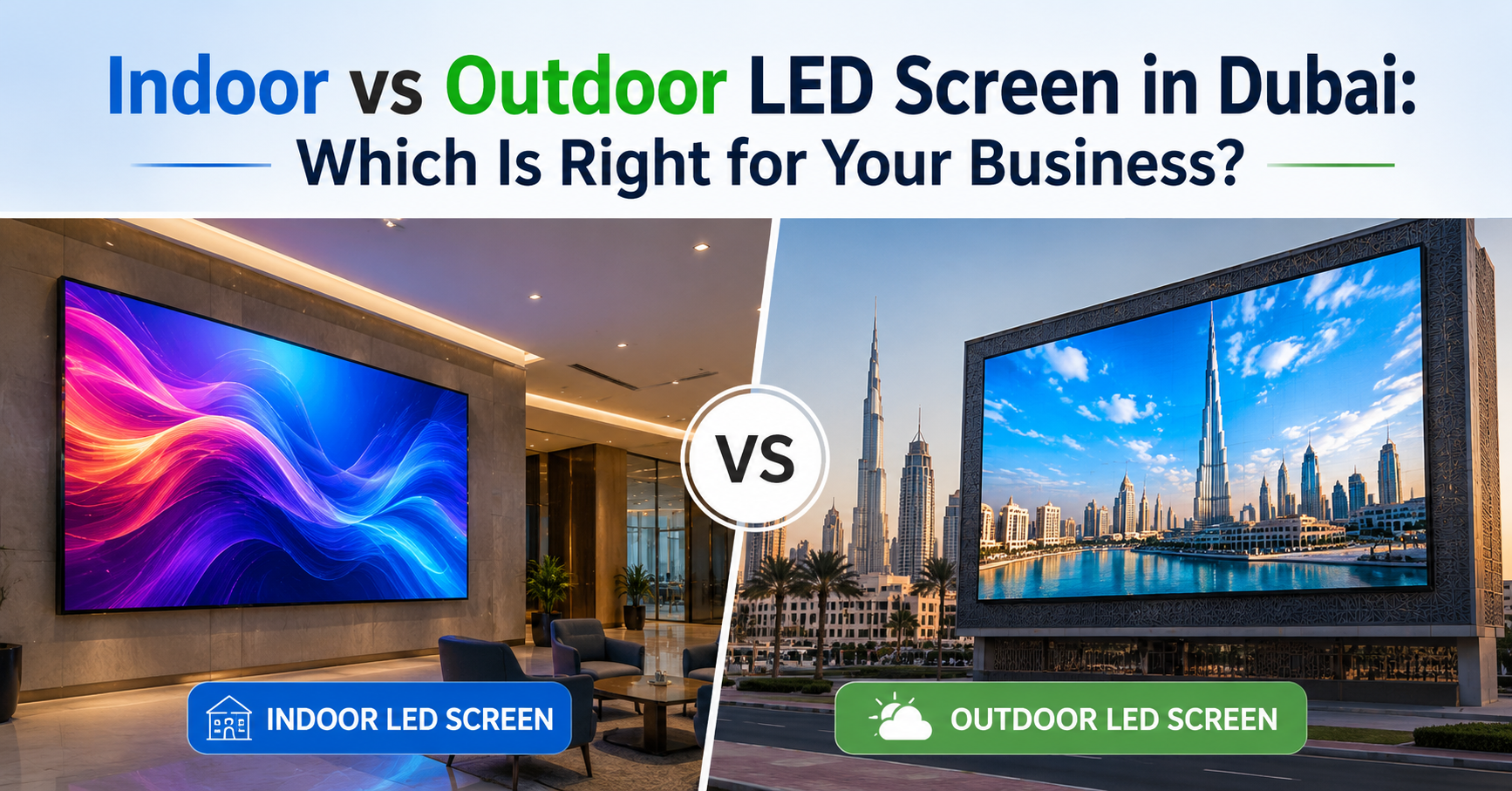
The choice between an indoor vs outdoor LED screen determines whether an investment returns results or repair bills. Indoor LED screens deliver sharp, colour-accurate visuals at close range in controlled environments — retail stores, hotel lobbies, mall atriums, corporate reception areas. Outdoor LED screens are engineered for a different mandate: sustain full brightness under direct sun, repel dust and humidity, and operate reliably in extreme heat. In Dubai, where surface temperatures on south-facing building facades in Al Quoz and Deira reach 65°C in July and ambient air temperatures consistently hit 41°C or above (National Centre of Meteorology), choosing the wrong screen type results in premature failure, inflated energy bills, and missed advertising impact. This guide provides a practical decision framework for Dubai businesses.
Indoor vs Outdoor LED Screens in Dubai: Which One Is Best for Your Business?
Before comparing specifications, start with the environment and use case. The table below maps business types to the right LED screen category, saving the detailed technical comparison for buyers who already know their direction.
| Business Type | Recommended LED Type | Primary Reason | Typical Size |
|---|---|---|---|
| Retail store | Indoor P2.5 / P3 | Close-view, 2–8 m | 3–10 sqm |
| Shopping mall (atrium) | Indoor P2.5 / P3 | High foot traffic, premium visuals | 10–50 sqm |
| Corporate lobby | Indoor P1.5 / P2 | Fine pitch, professional finish | 5–20 sqm |
| Hotel / hospitality | Indoor P2 / P2.5 | Luxury aesthetics, ambient lighting | 10–30 sqm |
| Restaurant / café | Indoor P3 / P4 | Menus, ambiance, promotions | 2–6 sqm |
| Outdoor advertising | Outdoor P6 / P8 | High brightness, wide viewing angle | 20–80 sqm |
| Real estate hoarding | Outdoor P6 / P8 / P10 | Long-distance visibility, 30–100 m | 30–100 sqm |
| Events / exhibitions | Indoor P3 or Outdoor P4 | Flexible, short-term, rental option | 10–60 sqm |
For most Dubai retail and hospitality businesses, the indoor LED digital displays Dubai retailers and hospitality operators install most frequently — P2 to P3 pixel pitch, 1,500–3,000 nits calibrated to environment, slim-frame cabinet — deliver high resolution at close range, energy-efficient operation, and visual quality that matches the premium standards the city’s consumers expect. For outdoor advertising, real estate hoardings, and building facade installations, only a purpose-built outdoor unit with certified weatherproofing and high-brightness LEDs will perform.
What Is the Difference Between Indoor and Outdoor LED Screens?
The engineering gap between indoor and outdoor LED displays is not superficial. It spans brightness, IP protection rating, thermal design, and structural load requirements. The table below compares the two types across all parameters relevant to a Dubai business buyer.
| Parameter | Indoor LED Screen | Outdoor LED Screen |
|---|---|---|
| Brightness | 1,500–3,000 nits (calibrated to environment) | 6,000–10,000 nits (Dubai direct sunlight) |
| Pixel pitch | P1.2–P3 (fine resolution) | P4–P10 (longer viewing distance) |
| Weatherproofing (IP) | IP31–IP54 (indoor only) | IP65–IP68 (dust + water proof) |
| Viewing distance | 1–12 metres | 8 metres to 100+ metres |
| Cabinet depth | Slim — 60–100 mm | Deep — 100–200 mm (cooling space) |
| Thermal management | Passive / fan cooling | Active cooling, heat-resistant materials |
| Operating temperature | 0–45°C | −20°C to 60°C engineered tolerance |
| Power consumption | Lower | Higher (brightness + cooling system) |
| Structural requirements | Wall mount / slim frame | Steel structure, wind-load rated, foundations |
| Regulatory approval | Usually not required | DM / RTA / Trakhees approval required |
The critical differentiator for Dubai is brightness. Direct midday sunlight in the UAE delivers up to 120,000 lux of ambient light. An indoor screen at 1,000 nits becomes completely invisible in those conditions. Outdoor LED displays rated at 7,000–10,000 nits maintain legible, vibrant images even at Sheikh Zayed Road midday. Mounting an indoor unit in an outdoor or semi-outdoor location — a common mistake by buyers seeking a lower purchase price — produces a screen that cannot be seen during peak business hours.
How Do LED Screens Work?
Understanding how LED screens work helps business buyers evaluate supplier claims and make accurate comparisons between products. An LED display is built from modular panels, each containing thousands of LED clusters (pixels) arranged at a defined pitch. Each LED cluster holds three diodes: red, green, and blue. By varying the intensity of each, the display produces the full visible colour spectrum.
The key components in any LED screen system:
- LED modules: The smallest replaceable unit. Module quality determines lifespan, colour accuracy, and brightness uniformity. Professional-grade modules use chips from manufacturers such as Nationstar, Cree, or Nichia.
- Receiving cards and sending cards: The signal chain that translates content from the media player to each LED module. Receiving cards process colour, brightness, and gamma per zone. Premium sending cards from Novastar or Linsn support automatic brightness adjustment based on ambient light sensors — important for outdoor screens in Dubai.
- Content management system (CMS): Software that schedules and publishes content across one or multiple screens. Cloud-based CMS platforms allow remote content updates from any device — a key operational advantage for multi-branch Dubai retailers.
- Power supply units: Distributed across the cabinet. Redundant power supply configurations prevent total screen failure if one unit trips.
- Thermal management: For outdoor units, active cooling (fan arrays, heat sinks) maintains module temperature within operating limits. In Dubai, thermal management is not optional — LED lifespan drops sharply when junction temperatures exceed manufacturer specifications.
Content is displayed dynamically, meaning the screen refreshes thousands of times per second. A refresh rate above 3,840 Hz ensures flicker-free capture by mobile phone cameras — relevant for hospitality and retail environments where guests photograph or film the display.
Which LED Screen Performs Better in Dubai’s Climate and Business Environment?
Dubai’s climate presents conditions that disqualify standard off-the-shelf screens from most outdoor installations. The average maximum temperature in August — Dubai’s hottest month — reaches 41°C, according to climate records from the UAE National Centre of Meteorology. In May 2025, inland UAE temperatures reached 51.6°C — the hottest May recorded in over two decades. Coastal Dubai consistently records 38–45°C in the summer months, combined with 55–70% relative humidity from Persian Gulf moisture.
What this means for LED screen selection in Dubai:
- Heat: Outdoor LED screens must have operating tolerances up to 60°C with active cooling systems. The steel mounting structure itself heats to temperatures that would warp sub-standard components.
- UV radiation: UAE UV Index regularly reaches 11–12 (extreme) from April to October. Cabinet faces, bezels, and module covers must use UV-stabilised polycarbonate and powder-coated steel to prevent yellowing and cracking.
- Dust storms (Haboob): Shamal winds bring fine-particle dust that infiltrates unsealed enclosures. IP65 dust-tight certification (per IEC 60529) is the minimum for any Dubai outdoor installation. IP66 or IP67 is strongly recommended within 3 km of the coast.
- Humidity and coastal salt: Coastal installations from Dubai Marina to Palm Jumeirah face salt-laden air that corrodes unprotected PCBs and metal contacts within 12–18 months. Marine-grade conformal coating on electronics and stainless-steel fasteners are non-negotiable for these locations.
Indoor screens perform flawlessly in air-conditioned environments. A best outdoor LED display for Dubai must carry IP65/IP67 certification, withstand thermal cycling from air-conditioned spaces to external heat exposure, and carry structural wind-load ratings compliant with Dubai’s building codes. iDesign’s outdoor units use aluminium extrusion cabinets with anti-UV coating, IP67-rated module sealing, and active cooling with thermal sensors that auto-adjust fan speed at 45°C to prevent module throttling.
How Do Brightness, Pixel Pitch, and Viewing Distance Affect LED Screen Performance?
The three technical variables that directly affect whether a screen delivers its intended marketing impact are brightness, LED screen pixel pitch, and viewing distance. Selecting any one of these incorrectly typically cannot be corrected after installation without replacing the screen.
Brightness (nits)
Brightness is measured in nits (candela per square metre). The required brightness depends entirely on ambient light conditions:
- Indoor (fully air-conditioned, artificial lighting): 1,500–3,000 nits — iDesign calibrates to the ambient lux of the specific installation environment, not maximum output.
- Semi-outdoor (covered but exposed — entry canopies, open mall corridors): 3,000–5,000 nits.
- Outdoor (full sun exposure): 6,000–10,000 nits. Screens below 6,000 nits wash out during Dubai’s midday hours. iDesign’s outdoor screens are specified at a minimum 6,000 nits as standard.
Pixel Pitch and Viewing Distance
Pixel pitch is the distance in millimetres between the centres of adjacent pixels. A smaller pitch (P1.5) means more pixels per square metre and a sharper image — but at proportionally higher cost. The practical rule: minimum viewing distance in metres ≈ pixel pitch in millimetres.
| Pixel Pitch | Min. Viewing Distance | Best For | Dubai Use Cases |
|---|---|---|---|
| P1.2 – P1.5 | 1.2–1.5 m | Fine pitch, ultra-close viewing | Corporate boardrooms, luxury hotel front desks, luxury retail |
| P2 – P2.5 | 2–2.5 m | Indoor retail, lobbies, showrooms | Mall atriums, showroom displays, airport check-in counters |
| P3 – P4 | 3–4 m | Events, restaurants, stage backdrops | DWTC exhibitions, hotel ballroom stages, café walls |
| P4 – P6 | 4–6 m | Outdoor events, building facade (close) | Outdoor event stages, podium facades, petrol station forecourts |
| P6 – P8 | 6–8 m | Outdoor billboard, street-level | Sheikh Zayed Rd billboards, retail park hoardings |
| P10 | 10+ m | Highway billboard, high-altitude | Emirates Rd, Al Khail Rd highway advertising boards |
Resolution and Screen Size Calculation
A 4 sqm indoor P2.5 screen has a resolution of approximately 640 × 640 pixels — sufficient for text, images, and video in a retail setting. A 30 sqm outdoor P8 screen produces a similar total pixel count but is designed to be read from 50 metres, not 2. Matching the pitch to the actual viewing scenario is the single decision that most differentiates an effective installation from an expensive one.
Which Businesses in Dubai Benefit Most from Indoor and Outdoor LED Screens?
LED screens deliver measurable commercial value across a wide range of Dubai business sectors. The application and return-on-investment profile differ significantly between screen types.
Indoor LED Display Applications in Dubai
- Retail stores (Dubai Mall, Mall of the Emirates): Product promotion, seasonal campaign rotations, and digital wayfinding. Indoor LED digital displays in Dubai’s premium malls replace static lightboxes with dynamic content that can be updated remotely without print costs.
- Corporate lobbies and boardrooms: Fine-pitch P1.5–P2 screens display live dashboards, brand video content, and video conferencing backgrounds. DIFC and Dubai Marina office towers frequently specify these for reception areas.
- Hotels and hospitality: Content at check-in, event advertising in corridors, and wayfinding in large resorts. Hospitality clients in Jumeirah and JBR typically require screens that meet the aesthetic standards of the surrounding environment.
- Restaurants and F&B: Dynamic menu boards, ambiance displays, and promotional content. The ability to update menus remotely across multiple branches in real time makes indoor LED screens a direct operational tool.
- Healthcare and education: Wayfinding in large hospital campuses, patient information displays, and auditorium screens in universities are growing categories for indoor LED in Dubai.
Outdoor LED Display Applications in Dubai
- Outdoor advertising on Sheikh Zayed Road and Emirates Road: High-dwell, high-visibility corridors with captive audience during peak commute hours. Roadside screens on these routes require RTA approval and brightness controls for nighttime compliance.
- Real estate development hoardings: Off-plan launches in Dubai Hills, JVC, and Downtown require large-format outdoor screens showing renders, pricing, and payment plan animations. The ROI on a P8 hoarding is typically recovered within 3–6 months of a successful off-plan launch event.
- Building facades and exterior branding: Branded towers in Business Bay and DIFC use outdoor LED mesh or cabinet screens on building skins. Facade installations require DM structural approval and landlord NOC.
- Events and outdoor exhibitions: GITEX, ADIPEC, Arab Health, and the Dubai Airshow all use outdoor LED stages and entry displays. P4–P6 rental screens are the standard for these formats.
What Does an Indoor vs Outdoor LED Screen Cost in Dubai?
LED screen pricing in Dubai splits across hardware, installation, structure, content management system, regulatory approvals, and ongoing maintenance. The table below provides indicative ranges for indoor LED screen price and outdoor LED screen price in Dubai across common pixel pitch categories, based on market rates as of 2026.
| Type | Pixel Pitch | Hardware Cost (AED/sqm) | Typical Screen Size | Indicative Project Total |
|---|---|---|---|---|
| Indoor | P2 / P2.5 | AED 7,000–15,000 | 4–10 sqm | AED 40,000–120,000+ |
| Indoor | P3 / P3.91 | AED 4,500–7,500 | 6–20 sqm | AED 35,000–80,000+ |
| Indoor | P4 | AED 3,500–5,000 | 10–30 sqm | AED 25,000–60,000+ |
| Outdoor | P4 / P5 | AED 5,000–8,000 | 10–20 sqm | AED 70,000–180,000+ |
| Outdoor | P6 / P8 | AED 3,500–6,000 | 20–50 sqm | AED 80,000–250,000+ |
| Outdoor | P10 | AED 2,500–4,000 | 30–80 sqm | AED 100,000–350,000+ |
Notes on total project cost calculation:
- Hardware price is the starting point. Total project cost typically runs 1.3 to 1.6 times the hardware price after installation, structure, cabling, and controller.
- Add 5% UAE VAT on all components and services.
- Outdoor installations add structural steel (AED 8,000–40,000 depending on size), wind-load foundation, electrical DEWA connection, and approval fees.
- RTA or Dubai Municipality application fees vary by location and screen size. Budget AED 5,000–25,000 for approval-related costs on roadside installations.
- Annual maintenance contracts for outdoor screens typically run 8–12% of hardware value per year.
Pricing from an unverified supplier 30% below market should trigger due diligence. Sub-standard LED modules from non-certified origins produce colour shift, brightness drop, and dead pixels within 12–18 months of operation in Dubai’s thermal environment.
Do LED Screens Require Dubai Municipality, RTA, or Other Approvals?
Outdoor LED screen installations in Dubai are regulated by multiple authorities, and operating without the required approvals can result in forced removal, fines, and licence suspension. The applicable authority depends on screen location, as confirmed by Dubai Municipality’s advertising regulations framework.
- Dubai Municipality (DM): Required for LED screens on private building facades and sites visible from public roads. DM reviews structural safety, size, brightness levels, and content compliance. Arabic text must be equal to or more prominent than English text on advertising displays per DM content guidelines.
- Roads and Transport Authority (RTA): Required for any LED screen facing a public road or highway. RTA evaluates driver distraction risk, screen brightness at nighttime, and sight-line impact. Brightness must comply with RTA specifications (typically auto-dimmed to below 1,000 nits during night hours).
- Trakhees / Free Zone Authority: Installations within JAFZA, Dubai Media City, Dubai Internet City, and other free zones fall under the respective zone authority’s regulations, not DM. Each free zone may have its own signage permit process.
- Dubai Civil Defense: Large-format or rooftop LED structures require Civil Defense sign-off on fire safety and electrical compliance, particularly for screens above 30 sqm.
- Landlord NOC: Any LED screen on a building that is not owned outright by the advertiser requires a No Objection Certificate from the property owner. This applies to tenants in malls, office towers, and retail parks.
Indoor LED screens in retail or corporate interiors generally do not require external authority approvals, though mall operators often have their own fitout guidelines governing screen type, brightness, and content scheduling.
Permit timelines for outdoor screens typically run 3–10 business days for standard applications, longer for large-format or highway-adjacent installations. Working with a supplier experienced in Dubai approvals reduces delays and avoids costly redesign cycles. Learn more about the approval process on the Dubai Municipality official website.
Read more: Signage Rules Dubai Mall Tenants Must Follow
What Common Mistakes Should Businesses Avoid When Choosing LED Screens?
Based on iDesign Advertising’s 11+ years of LED installations across the UAE, these are the buyer errors that consistently result in wasted investment:
- Choosing brightness by guesswork. An indoor-spec screen (800 nits) mounted in a semi-outdoor lobby becomes invisible in daytime. Always match brightness to the measured ambient lux level of the installation location.
- Wrong pixel pitch for the viewing distance. A P6 screen in a 3-metre-wide retail corridor produces a visibly pixelated image. A P2.5 screen on a highway billboard wastes budget on resolution no viewer can perceive at 80 metres.
- Placing indoor LED screens outdoors. Indoor units have IP31–IP54 ratings. Dubai’s dust storms and humidity penetrate these enclosures within weeks. The warranty is void and the repair cost typically exceeds the original purchase price.
- Selecting on price alone. Budget imports from uncertified suppliers frequently use off-spec LED chips that produce colour inconsistency, brightness decay, and high dead-pixel rates within 18 months. The total cost of ownership over five years is almost always higher than a certified premium product.
- Ignoring approval requirements before purchase. Ordering a screen before confirming the approval pathway leads to either forced removal or expensive structural modifications. DM and RTA have specific size and brightness limits for many locations.
- Underestimating maintenance costs. Outdoor screens in Dubai require quarterly cleaning (dust accumulation blocks airflow and increases operating temperature), annual electronic inspections, and planned module replacement. Buyers who budget only the purchase price are routinely surprised.
- No content management strategy. A static-image loop on a dynamic LED screen wastes the medium’s primary advantage. Without a CMS plan and content update schedule, the screen produces no better ROI than a printed banner.
Are LED Screens Worth the Investment for Dubai Businesses?
The short answer for most Dubai businesses: yes, when the screen type, size, and location are correctly matched to the marketing objective.
Four factors make LED screens commercially viable in Dubai’s business environment:
- Dynamic content at zero marginal cost: A retailer running eight seasonal campaigns per year pays AED 0 for content changes after the initial CMS setup, compared with AED 3,000–15,000 per print-and-install cycle for static lightboxes.
- Visibility in a competitive advertising environment: Dubai’s retail and outdoor advertising density is among the highest in the GCC. Static signage competes poorly for attention alongside movement and light. A 5 sqm indoor P2.5 wall in a retail window creates a visible landmark that static material cannot replicate.
- Long operational life: Quality LED screens are rated for 80,000–100,000 hours (8–11 years at 10 hours/day operation). Amortised across that lifespan, the per-day cost of the asset is lower than most printed alternatives refreshed annually.
- Real estate and brand premium: LED screens in hotel lobbies, corporate reception areas, and luxury retail environments are increasingly an expected part of the customer experience. Their absence is noticed. Their presence communicates investment in brand standards.
The investment case is weakest when a business installs a screen in a low-traffic location, runs no dynamic content strategy, or selects undersized hardware that cannot deliver contrast in the ambient lighting conditions. Those cases produce a low-ROI asset. The cases that succeed share a common pattern: right screen, right location, active content.
How to Choose the Right LED Screen Supplier in Dubai
Whether searching for an indoor LED screen supplier in Dubai or an outdoor LED screen supplier in Dubai, the evaluation criteria below filter qualified partners from resellers and box-movers. iDesign’s full LED Display Screen service page details what a complete end-to-end LED supply scope looks like.
Supplier evaluation checklist:
- ISO certifications: ISO 9001 (quality management), ISO 14001 (environmental), and ISO 45001 (occupational health and safety) indicate operational maturity. They are not universal — verify certification numbers directly.
- In-house fabrication vs. full resale: Suppliers with in-house fabrication capability can customize screen formats, bezels, and mounting structures for non-standard spaces. Pure resellers cannot.
- Verifiable local project portfolio: Ask for project addresses and client references in Dubai. Walk-through visits to installed screens are standard practice for orders above AED 50,000.
- Approval support: A competent supplier handles DM, RTA, and Trakhees submissions as part of the installation scope, not as a separately billed service. Confirm this before contract signing.
- Warranty terms in writing: iDesign Advertising provides a 3-year warranty covering hardware failure, wiring faults, and module replacement — confirmed on their service page. Confirm equivalent warranty terms, in writing, with any other supplier. Offshore suppliers offering 12-month module warranties should be scrutinised for after-sales service access.
- Maintenance and spare parts availability: LED cabinets use receiving cards and modules that are model-specific. Confirm the supplier stocks spare parts locally. Modules out of production cannot be matched in colour temperature, creating visible dead zones.
- Content management system capability: The supplier should demonstrate and support the CMS, not hand over a manual. Cloud-based CMS with remote update capability is the standard for multi-location Dubai operators.
- How to choose the right LED screen: A qualified supplier conducts a site survey (measuring ambient lux, viewing distances, and structural load points) before specifying hardware. Suppliers who quote from a screen size alone without a site survey are guessing.
Read more: How to Choose the Best LED Screen Supplier in UAE: What to Look For?
Why Choose iDesign Advertising for LED Screen Solutions in Dubai?
iDesign Advertising LLC operates from its Al Qusais facility in Dubai and has delivered LED screen projects across Dubai, Sharjah, Abu Dhabi, and the wider UAE since 2015. The company holds ISO 9001, ISO 14001, and ISO 45001 certifications — independently audited standards covering quality, environmental management, and workplace safety. Named installations include Emaar retail environments, Lulu Hypermarket in-store promotional walls, ADNOC forecourt communications screens, and American Hospital patient communication displays.
What this means for a business buying an LED screen in Dubai:
- In-house fabrication facility: Screen structures, bezels, and mounting assemblies are fabricated internally, enabling custom sizing for non-standard architectural spaces. Off-plan retail fits, curved facades, and modular event configurations are handled without third-party dependency.
- End-to-end project scope: Design, LED module selection, fabrication, installation, regulatory approval submissions, and post-installation maintenance are managed as a single scope. Businesses deal with one point of accountability.
- Dubai approvals experience: iDesign’s team has processed DM, RTA, and Trakhees LED screen approvals across Dubai’s commercial districts and free zones. This eliminates the approval learning curve that often delays competitor-sourced projects by 4–8 weeks.
- 650+ UAE client portfolio: Installations span retail, hospitality, corporate, real estate, healthcare, and government sectors across the UAE and Saudi Arabia.
- After-sales maintenance contracts: Quarterly servicing schedules, emergency response SLAs, and spare-parts stocking agreements available for all permanent installations.
Conclusion: Ready to Choose the Right LED Screen for Your Business?
Indoor and outdoor LED screens serve fundamentally different commercial functions. Indoor screens deliver fine-resolution, dynamic content at close range in controlled environments — retail, hospitality, corporate, and F&B. Outdoor screens are engineered for Dubai’s sun, dust, and heat, built to sustain visibility at 7,000–10,000 nits across viewing distances of 8 to 100 metres.
The three decisions that determine success are: screen type matched to environment, brightness matched to ambient conditions, and pixel pitch matched to viewing distance. Regulatory approvals for outdoor installations add a project management layer that is best handled by a supplier with established relationships with Dubai Municipality, the Roads and Transport Authority, and the relevant free zone authorities.
iDesign Advertising provides free consultations and detailed site surveys for LED screen projects across Dubai and the wider UAE. Contact the iDesign team at idesignads.ae/contact-us to receive a specification report and a customised quote for your location and business objective.
Frequently Asked Questions About Indoor vs Outdoor LED Screens in Dubai
Which is better for my business in Dubai — an indoor or outdoor LED screen?
It depends on the installation location and viewing distance. If the screen is in an air-conditioned interior visible to customers within 2–12 metres, an indoor LED screen is the correct choice. If the screen is exposed to sunlight, dust, or rain — even partially — an outdoor-rated screen with IP65+ certification and minimum 6,000 nits brightness is required.
What brightness level is required for outdoor LED screens in Dubai’s sunlight?
Outdoor LED screens in Dubai require a minimum of 6,000 nits to remain legible in direct sunlight — this is iDesign’s stated standard specification for all Dubai outdoor deployments. For screens facing southwest or highway locations with high ambient light reflection, 7,000–10,000 nits is the practical specification.
What pixel pitch should I choose for my LED screen?
Apply the distance-in-metres rule: minimum viewing distance equals pixel pitch in millimetres. A retail screen viewed from 2–3 metres needs P2 or P2.5. A roadside billboard viewed from 40–80 metres needs P6–P10. The LED screen pixel pitch also determines the number of pixels per square metre and therefore the total resolution of the display.
How much does an indoor or outdoor LED screen cost in Dubai?
Indoor P2.5 screens run AED 7,000–15,000 per sqm in hardware cost, with full project costs for a 6 sqm retail wall typically landing between AED 40,000 and AED 90,000 including installation and CMS setup. Outdoor P6/P8 screens start from AED 3,500–6,000 per sqm in hardware; total outdoor projects including structure, approvals, and installation typically range from AED 80,000 to AED 250,000+ depending on scale.
Do LED screens require Dubai Municipality or RTA approvals?
Outdoor LED screens in Dubai require approval from Dubai Municipality (for private building facades and non-road-facing sites), the Roads and Transport Authority (for screens visible from or facing public roads), or Trakhees/free zone authority (within free zones). Indoor LED screens in retail or corporate interiors do not typically require external authority approvals, though mall operator guidelines may apply.
Which LED screen lasts longer in Dubai weather?
A properly specified outdoor LED screen with IP65/IP67 protection, thermal management, and certified LED modules is designed for 80,000–100,000 hours of operation — equivalent to 8–11 years at standard operating schedules. Indoor screens in air-conditioned environments can achieve similar lifespans at lower maintenance cost. The primary lifespan variable is ambient operating temperature; every 10°C above the LED junction temperature specification reduces estimated lifespan by approximately 30%.
How much maintenance do LED screens require?
Outdoor LED screens in Dubai should be serviced quarterly: air filter cleaning, cabinet seal inspection, module temperature check, and electrical connection re-torquing. Annual maintenance should include a full electrical inspection and pixel uniformity calibration. Indoor screens require less frequent servicing — typically biannual cleaning and a yearly electronics check. Maintenance contracts are available from qualified suppliers and typically cost 8–12% of the original hardware value per year for outdoor installations.
Note: Regulatory requirements, permit fees, and authority contacts are subject to change. Verify current requirements with Dubai Municipality (dm.gov.ae) or the Roads and Transport Authority (rta.ae) before commencing an outdoor LED screen project.
Related Posts
September 29, 2025
The Best Signage Company in Dubai: Key Features to Look For
On a warm evening in Dubai, Amal, a young entrepreneur, stood outside her soon-to-open boutique…