




No products in the cart.
Signage Cost Guide Dubai 2026: What Does Business Signage Actually Cost?
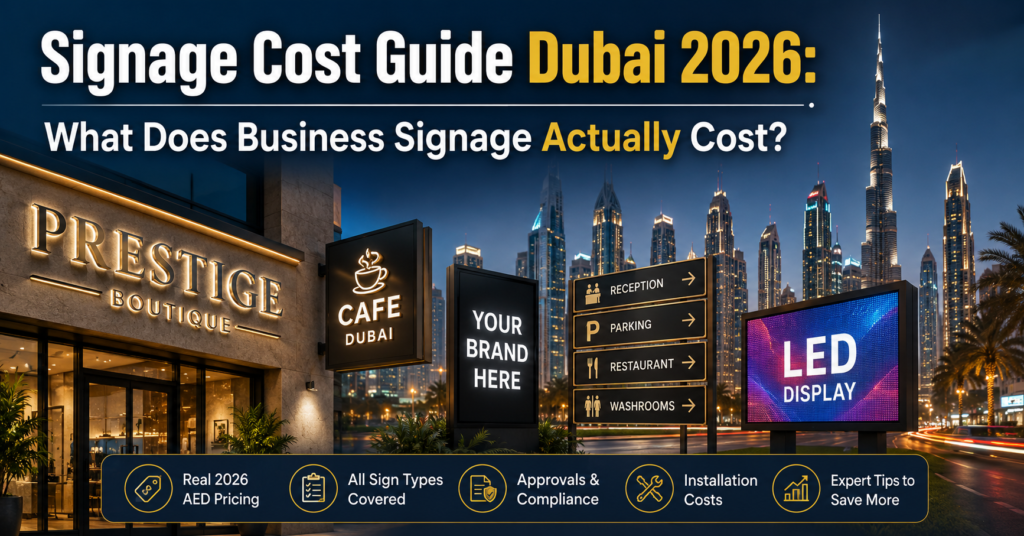 The average cost of signage for a business in Dubai ranges from AED 300 for a basic acrylic nameplate to AED 80,000+ for a custom LED video wall — and the distance between those two figures is determined by five variables: signage type, dimensions, illumination, installation complexity, and regulatory approvals. A shopfront sign on Sheikh Zayed Road carries different engineering, permit, and material requirements than the same sign inside a JLT office lobby. This guide sets out real 2026 AED cost ranges across every major signage category used by Dubai businesses — retail, restaurants, clinics, offices, malls, and hospitality — so you can budget accurately before approaching any supplier.One pattern holds consistently across Dubai signage projects: buyers who select the lowest fabrication quote without accounting for approval fees, structural certification, and climate-grade materials typically spend more within 18–24 months on maintenance, non-compliant sign removal, or replacement. Material grade, climate performance, and regulatory compliance are not optional budget lines — they are part of the real cost of signage in the UAE.
 How Much Does Business Signage Cost in Dubai in 2026?
The table below sets out indicative AED ranges for common commercial signage categories. These are estimated starting prices — final project costs depend on dimensions, site conditions, electrical requirements, approval scope, and whether the supplier fabricates in-house or outsources. All figures reflect fabrication; installation and approvals are itemised separately later in this guide.| Signage Type | Estimated Range (AED) | Typical Business Use |
| Acrylic flat-cut letters/panels | AED 300 – 1,500 | Offices, clinics, retail interiors |
| Lightbox / backlit signboard | AED 800 – 4,500 | Shopfronts, reception counters |
| 3D illuminated channel letters | AED 1,500 – 8,000 | Retail, F&B, hotel façades |
| LED shopfront branding | AED 2,000 – 15,000 | Restaurants, fashion, real estate |
| Outdoor restaurant sign (LED) | AED 3,000 – 12,000 | F&B outlets — outdoor-rated, IP65 |
| Wayfinding / directional system | AED 5,000 – 25,000 | Malls, hospitals, corporate towers |
| Outdoor LED display (static) | AED 10,000 – 40,000 | Building façades, roadside, petrol forecourts |
| LED video wall / digital display | AED 15,000 – 80,000+ | Showrooms, hotel lobbies, real estate |
| Neon / neon-flex signs | AED 800 – 3,500 | Cafés, gyms, events, interiors |
| Safety & wayfinding (ISO-compliant) | AED 200 – 1,500 | Warehouses, factories, civil defense |
| Vehicle / fleet branding | AED 500 – 3,000 per unit | Delivery, corporate fleets, clinics |
What Factors Affect Signage Pricing in Dubai?
Two signs that look nearly identical on a design brief can differ by AED 5,000 or more in final project cost. Here is why.1. Dimensions and Surface Area
Signage fabrication is priced per square metre for most types. A 1m × 3m LED lightbox costs roughly three times a 1m × 1m version in materials — but installation labour and approval fees don’t scale proportionally, making larger signs more cost-efficient per square metre once the fixed costs are absorbed.2. Illumination Method
Non-illuminated acrylic or aluminium signs carry the lowest fabrication cost. Backlit LED modules add 30–50% to materials. Front-lit channel letters with individual LED modules cost more per letter than backlit panels. Full RGB LED video walls are an order of magnitude above static LED — the pixel pitch (P1.5, P2.5, P4, P6) determines resolution and price per square metre.3. Material Grade for Dubai Climate
Dubai’s summer ambient temperature reaches 45–50°C. Sign surfaces in direct sun regularly hit 70°C+. Standard-grade PVC and low-density acrylic warp, yellow, or delaminate within 12–18 months of outdoor exposure. Marine-grade aluminium, UV-stabilised polymers, and IP65-rated LED drivers and enclosures are the minimum specification for any outdoor Dubai signage — and they cost more than temperate-climate equivalents. This is not a premium; it is the baseline for performance.4. Arabic Branding Compliance
Dubai Municipality requires Arabic text on all public-facing commercial signage, with Arabic characters no smaller than the English equivalent. Custom Arabic typography for 3D channel letters or illuminated builds requires specialist design and additional fabrication time. Signs submitted without correctly sized Arabic text are rejected at technical review, restarting the approval clock by 4–10 working days.5. Installation Environment
Ground-floor retail installation is straightforward. High-rise façade mounting, rooftop structures, or mall ceiling rigs require scaffolding, cherry pickers, or crane hire — any of which adds AED 2,000–8,000 to installation cost, independent of fabrication. Night-only installation requirements in certain residential-adjacent commercial areas carry a 20–30% labour premium.6. Structural Engineering Certification
Outdoor signs fixed above 2.5m height, or with a height dimension above 2.5m, require a structural calculation certificate from a DEWA- and DM-approved UAE engineer before a permit is issued. Engineering certification typically costs AED 800–2,500 and must be resubmitted if the sign is relocated or modified after installation.Signage Cost by Type — Detailed Dubai Pricing Breakdown
Acrylic Signage
Flat-cut acrylic letters and panels are the standard indoor choice for reception areas, meeting rooms, office nameplates, and retail interiors. Non-illuminated: AED 300–800 for small panels; backlit acrylic: AED 800–2,500 for medium shopfront use. Acrylic requires UV-stabilised coatings for any outdoor application in Dubai — standard-grade acrylic is an indoor material in this climate.3D Illuminated Channel Letters
The most common shopfront branding choice in Dubai retail strips and commercial towers. Individual letters are fabricated from powder-coated aluminium with front or halo LED illumination. AED 1,500–8,000 for standard shopfront runs; large-format hotel or tower installations reach AED 15,000–40,000+ depending on letter height and finish spec.LED Lightboxes
Single-face and double-face lightboxes are used across mall kiosks, pharmacy shopfronts, and food court outlets. AED 800–4,500 for standard sizes (600mm × 900mm to 1200mm × 600mm). Custom-shaped lightboxes with curved profiles add 25–40% to fabrication cost. Outdoor lightboxes require IP65 enclosures and UV-rated diffuser panels.LED Video Walls and Digital Displays
Indoor LED video walls (hotel lobbies, real estate showrooms) start at AED 15,000 for a 2m × 1m P2.5 pitch display and scale to AED 80,000+ for large-format modular installations. The price of digital display boards for outdoor use — building façades, roadside, petrol forecourts — requires IP65-rated panels with 5,000–10,000 nit brightness for Dubai sunlight readability, carrying a 40–60% premium over indoor-spec panels.Restaurant Signage
The cost of outdoor business signs for F&B — restaurant signs, café fascia boards, food court LED displays — typically falls between AED 3,000 and AED 12,000 for a single-frontage ground floor installation. This range covers LED-illuminated aluminium shopfronts, outdoor-rated materials, and DEWA electrical connection. Larger restaurant groups with high-footfall locations invest AED 15,000–25,000+ per outlet for double-face illuminated fascia and branded entrance structures.Wayfinding and Directional Systems
Hospital, mall, hotel, and corporate campus wayfinding involves multiple sign types — overhead hanging signs, floor pylons, door plates, directory boards — with consistent material and typographic specification. AED 5,000–25,000 for a mid-sized commercial project; large hospital or mall systems exceed AED 50,000 in fabrication alone, before structural and approval costs.Why Is Outdoor Signage More Expensive Than Indoor Signage in Dubai?
Dubai’s outdoor environment is among the most demanding for signage anywhere in the world. UV index regularly exceeds 11 (the global maximum), summer temperatures push material limits, Saharan dust infiltrates every non-sealed enclosure, and coastal humidity accelerates corrosion in zones near the sea. The cost difference between an indoor and outdoor sign of identical visual dimensions is not markup — it is engineering.| Factor | Indoor Signage | Outdoor Signage — Dubai |
| UV resistance | Not required | Mandatory — UV-stabilised coatings or polymer |
| Heat tolerance | Up to 40°C typical | Engineered for 50°C ambient; surfaces reach 70°C+ |
| Waterproofing | Not required | IP65 rating minimum for enclosures and LED drivers |
| Structural approval | Rarely required | Mandatory for wall-mounted or freestanding above 2.5m |
| Electrical permit | Basic wiring (DEWA if >20A) | Full DEWA NOC + inspection required before power-on |
| Installation method | Standard mounting | Scaffolding, cherry picker, or crane depending on height |
| Material grade | Standard acrylic / aluminium | Marine-grade aluminium, powder-coated steel |
| Coastal zones | Standard finish | Stainless fixings required — JBR, Marina, Palm, Creek |
| Cost premium | Baseline | +30% to +90% vs equivalent indoor specification |
Do Dubai Municipality, RTA, Civil Defense, or Mall Approvals Add to Signage Cost?
Yes — and the authority governing your signage depends on where your business is located, not just what type of sign you’re installing. A single project can require approvals from two or three authorities in sequence. Submitting to the wrong authority results in rejection without review.| Authority | Jurisdiction | Signage Covered | Approx. Fee |
| Dubai Municipality (DM) | Mainland Dubai commercial areas | Shopfronts, outdoor, building façades | Per sq.ft — submit at smartadv.dm.gov.ae |
| Dubai Development Authority (DDA) | TECOM free zones — DMC, DIC, DSC, DKP | All signage within the free zone | AED 500–5,000 per year by type |
| Trakhees | JAFZA, Dubai South, Palm Jumeirah | All external signage within DP World zones | Separate Trakhees fee schedule |
| DMCC | Jumeirah Lakes Towers (JLT) | All signage on DMCC-registered premises | Via DMCC Concordia system |
| DIFC Authority | Dubai International Financial Centre | All signage within the DIFC boundary | DIFC Authority fee schedule |
| RTA | Signs facing roads/highways | Roadside billboards, directional | AED 1,000–5,000 (add-on to primary permit) |
| Civil Defense (DCD) | All premises — fire safety compliance | Emergency exits, safety signage | Varies — mandatory for relevant types |
| DEWA | Any illuminated or electrical signage | LED, lightbox, electrical connection | AED 500–2,000 + inspection |
| Mall Management | Inside / on mall property | Shopfront, kiosk, banner, wayfinding | Set by individual mall operator |
What Hidden Signage Costs Do Businesses Often Miss?
The fabrication quote rarely reflects the full project cost. These are the line items that typically appear after the purchase order is signed:- Scaffolding or cherry picker hire: AED 1,500–5,000 per day — required for most façade installations above 4m
- Crane hire for large formats: AED 3,000–8,000 per mobilisation — required for heavy 3D letter rigs or rooftop structures
- Night installation surcharge: 20–30% labour premium — mandatory in some malls and residential-adjacent zones
- Structural engineering certificate: AED 800–2,500 — required for outdoor signs above 2.5m height threshold
- Sector-specific NOC fees: RERA, DHA, KHDA — charged by the issuing authority; timeline impacts are often more costly than the fee itself
- Old signage removal and disposal: AED 500–2,500 — required before new installation when removing cored-in anchor points from concrete or masonry
- Electrical conduit and wiring: AED 800–3,000 — DEWA-licensed electrical contractor required and cannot be the sign fabricator’s team unless separately licensed
- Design revision cycles: Beyond 2–3 rounds, most suppliers charge AED 300–800 per additional revision — Arabic typography corrections are the most common trigger
- Annual maintenance contract (AMC): AED 500–3,000 per year — essential for LED systems; most manufacturer warranties require documented AMC to remain valid
- Permit renewal: DDA and Dubai Municipality permits are valid for 1 year and must be renewed before expiry. A lapsed permit requires a full new application, not a simple renewal
Which Signage Type Offers the Best ROI for Different Businesses?
Return on signage investment is not uniform across industries. A decision that makes commercial sense for a mall-facing restaurant does not apply to a B2B logistics operation.| Industry | Recommended Signage | Primary Goal | ROI Outlook |
| Retail / Fashion | 3D LED shopfront + lightbox | Foot traffic, impulse decisions | High — direct visibility-to-entry impact |
| F&B / Restaurants | Outdoor LED sign + digital menu board | Dwell time, daily specials, upsell | High — outdoor restaurant sign eliminates recurring print cost |
| Mall outlet | Illuminated fascia + wayfinding | Brand recall, navigation | Very High — mall footfall leverage at decision point |
| Corporate office | Reception signage + directional | Brand perception, visitor orientation | Medium — client confidence and first impression |
| Clinic / Healthcare | Acrylic + safety + wayfinding | Patient trust, DHA compliance | Medium — regulatory requirement + brand signal |
| Hospitality / Hotels | LED façade + lobby digital wall | Premium brand positioning | High — direct influence on perceived room value |
| Real estate showroom | LED video wall + floor graphics | Sales conversion at point of visit | Very High — single screen compresses sales cycle |
| Warehouse / Industrial | Safety signage + directional | Civil Defense compliance, safety | Mandatory — regulatory, not discretionary |
How to Reduce Signage Costs Without Compromising Quality
1. Match Material Grade to Actual Environment
Marine-grade aluminium and IP65 enclosures are necessary for outdoor coastal locations — not for an air-conditioned mall interior. Specifying outdoor materials for an indoor sign adds cost without benefit. A pre-installation site survey — offered free by most reputable Dubai suppliers — identifies the correct spec before fabrication begins.2. Combine Approval Submissions
If a project involves multiple sign types — shopfront, wayfinding, and safety — submitting all under one approval package saves 30–40% on permit costs compared to separate submissions. Experienced signage companies structure packages this way as standard. Ask directly before engaging a supplier.3. Specify the Correct Lift Equipment
For installations between 3m and 6m, a hydraulic working platform is significantly cheaper than a cherry picker or crane. Some suppliers default to higher-cost access equipment without checking site access first. Confirm the access method in writing as part of the installation quote.4. Order in Production Runs
If you are opening multiple locations, ordering signage in a single production run — even when installation is phased — reduces per-unit material cost by 15–25% and eliminates repeat setup and design charges. Standardising signage specification across a chain also simplifies future approval submissions.5. Work with In-House Fabricators
Suppliers who subcontract fabrication add their coordination margin to the buyer’s cost. In-house fabrication — where design, cutting, welding, painting, and LED installation happen under one roof — reduces cost and shortens timelines. Ask for a production capability statement or factory visit before committing to a quote.Choosing a Signage Partner in Dubai: What iDesign Advertising Covers
iDesign Advertising operates as a full-service signage company handling design, in-house fabrication, regulatory approvals, professional installation, and post-installation maintenance across Dubai and the wider UAE. The company manages Dubai Municipality submissions, DDA (TECOM free zone) approvals, Trakhees (JAFZA, Dubai South, Palm) submissions, DMCC (JLT) filings, and DIFC Authority applications — under one engagement, without the buyer needing to coordinate separately with each authority.In-house fabrication covers acrylic, aluminium, steel, LED channel letters, lightboxes, digital displays, wayfinding systems, vehicle branding, and large-format outdoor structures. For businesses requiring bilingual Arabic-English signage — the standard for all public-facing commercial signage in Dubai — the design team handles compliant Arabic typography as part of the standard scope. For a full breakdown of signage installation timelines and the step-by-step installation process in Dubai, see iDesign’s signage installation process guide.Conclusion: What Your Signage Budget Should Actually Cover
Signage pricing in Dubai is a function of material performance, climate engineering, regulatory compliance, and installation complexity — not just the size of the sign face. A quote covering fabrication only, with approvals, structural engineering, and installation listed as ‘as applicable,’ is not a complete budget. Businesses that manage signage costs effectively in Dubai request scope-complete quotes from day one, verify which authority applies to their specific location and business type, and factor in annual maintenance before committing.Cheap signage that fails under Dubai’s UV load, gets rejected by Dubai Municipality, or needs emergency replacement within two years is not cheap signage — it is expensive signage paid twice.| REQUEST A SIGNAGE QUOTE — iDesign Advertising, Dubai iDesign Advertising handles end-to-end signage projects across Dubai — design, in-house fabrication, approval submissions across Dubai Municipality, DDA, Trakhees, DMCC, and DIFC Authority, professional installation, and annual maintenance contracts. For a scope-based quote tailored to your business type and location: idesignads.ae/signage-installation-dubai-complete-process-cost-timeline-guide Or visit the main site: idesignads.ae |
Frequently Asked Questions About Signage Costs in Dubai
1. How much does a shop signboard cost in Dubai?
A shop signboard in Dubai costs between AED 1,500 and AED 15,000 depending on size, illumination, and materials. A basic acrylic flat-cut board starts around AED 500–1,500. A fully illuminated 3D LED shopfront reaches AED 8,000–15,000. Dubai Municipality approval, DEWA electrical permits, structural engineering certification, and installation labour add AED 1,000–5,000 on top — and are rarely included in the initial fabrication quote.
2. What is the cost of 3D signage in Dubai?
3D illuminated channel letters cost AED 1,500–8,000 for standard shopfront applications. Larger formats for hotel façades, malls, or towers range from AED 10,000 to AED 40,000+, depending on letter height, LED module grade, and powder-coat specification. Arabic-English bilingual builds carry a 20–30% premium over single-language equivalents of the same linear footage.
3. Are signage approvals included in signage pricing?
Not by default. Dubai Municipality approval is calculated per square foot of sign area. DEWA electrical permits add AED 500–2,000. Structural engineering certificates add AED 800–2,500. Businesses in real estate, healthcare, or education require additional sector NOCs from RERA, DHA, or KHDA respectively before the primary permit is issued. Full-service suppliers handle all of this as part of the project scope — confirm in writing before signing any quote.
4. Why is outdoor signage more expensive than indoor signage?
Dubai’s outdoor environment — 40–50°C ambient summer temperatures, UV index above 11, Saharan dust, and coastal humidity — requires marine-grade aluminium, IP65-rated LED enclosures, anti-UV coatings, and structurally certified mounting systems. DEWA permits, Civil Defense compliance, and crane or scaffold installation add further cost. The combined premium over equivalent indoor signage is 30–90%.
5. How long does signage installation take in Dubai?
Simple shopfront signage: 2–3 weeks from consultation to activation. LED digital displays: 4–6 weeks. Large commercial projects: 6–12 weeks. Approval-only timelines range from 4 working days (DDA) to 20 working days (RTA). A single incomplete document submission restarts the review clock by 4–10 working days. Any supplier quoting “3–7 days” is excluding the approval phase from the timeline.

About Althaf Hussain
Althaf Hussain is the CEO and Founder of iDesign Advertising LLC, one of the UAE’s leading signage and advertising companies, established in Dubai in 2015. With 11+ years delivering signage projects in the UAE signage and advertising industry, Althaf has built iDesign into a trusted partner for businesses across Dubai, Sharjah, Abu Dhabi, and the wider GCC — including Saudi Arabia, where the company operates from its Riyadh office.