The UAE has officially declared 2026 as the Year of the Family – a national vision that prioritizes stronger communities, safer environments, and inclusive public spaces.
But here’s the real question for businesses:
Is your space truly designed for everyone in the family?
From toddlers and teenagers to parents and grandparents, families experience spaces differently. And signage plays a silent yet powerful role in shaping that experience.
In retail, healthcare, hospitality, and public environments across Dubai and the wider UAE, inclusive signage is no longer optional – it’s strategic.
Why Inclusive Signage Matters in 2026
When families enter a mall, hospital, school, or entertainment venue, they look for three things:
Clarity
Comfort
Confidence
Poorly designed signage creates friction:
Confusing directions
Hard-to-read fonts
Poor lighting
Language barriers
Signs placed too high for children or too low for elderly users
Good signage reduces stress.
Great signage builds trust.
And in the Year of the Family, trust becomes a competitive advantage.
Readable Fonts: Designing for Every Age Group
Typography is not just design. It’s accessibility.
BEST PRACTICES:
Use high-contrast color combinations
Avoid overly decorative fonts
Ensure sufficient letter spacing
Maintain appropriate font size based on viewing distance
Elderly visitors may struggle with small or condensed fonts. Children may rely more on visual cues than text.
In family-focused environments across Dubai malls and community centers, legibility directly impacts user experience.
Multilingual Messaging: Respecting Cultural Diversity
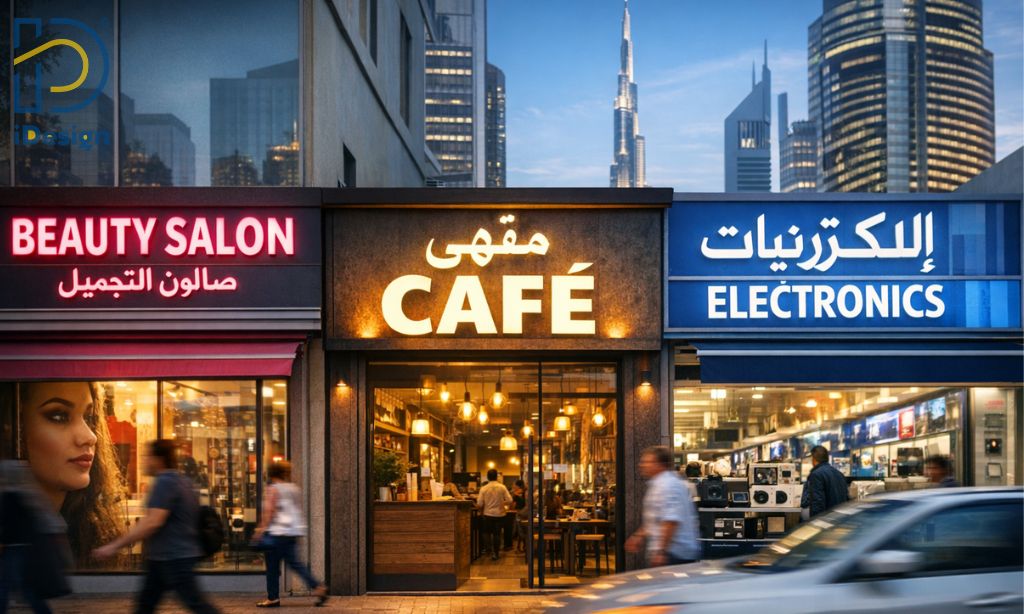
The UAE is home to over 200 nationalities. Families often include members with different language preferences.
Inclusive signage should consider:
Arabic (primary)
English (secondary)
Icons that reduce reliance on language
Clear bilingual signage:
Improves navigation efficiency
Reduces staff intervention
Enhances brand perception
In public institutions and retail hubs, multilingual wayfinding is not just a regulation – it’s a responsibility.
Intuitive Icons: Universal Communication
Children may not read fluently.
Visitors may not speak the language.
Elderly users may process visuals faster than text.
That’s where icons become powerful.
Effective icons:
Are simple and uncluttered
Use universal symbolism
Maintain consistent visual language throughout the facility
Restrooms, elevators, prayer rooms, baby-changing stations, exits — these should be identifiable within seconds.
When icons are clear, families move confidently.
Proper Lighting: Visibility Equals Safety
Lighting transforms signage effectiveness.
Backlit LED signs, light boxes, and illuminated wayfinding systems ensure:
Visibility in low-light environments
Reduced eye strain
Improved nighttime navigation
In malls, hospitals, parking areas, and entertainment zones, illuminated signage increases perceived safety – especially for families with children.
Poor lighting leads to hesitation.
Good lighting encourages movement.
Smart Placement: Designing for Real Human Behavior
Sign placement is often underestimated.
Inclusive placement means:
Mounting signs at multiple viewing heights
Avoiding obstruction by décor or displays
Positioning directional signs before decision points (not after)
For example:
Children’s zones should have lower-level visual cues
Emergency exits should be clearly visible from a distance
Elderly-friendly facilities should be clearly marked near entrances
When signage aligns with natural walking paths, it reduces cognitive load.
Inclusive Signage as a Revenue Strategy
Inclusive signage doesn’t just improve experience.
It improves commercial performance.
Clear navigation:
Increases dwell time
Reduces frustration
Improves store discovery
Enhances brand perception
Families that feel comfortable stay longer.
Families that stay longer spend more.
In retail environments across the UAE, experience directly influences revenue.
Final Thoughts
Designing for all ages is not about adding more signs.
It’s about designing smarter signs.
In the UAE’s Year of the Family, signage becomes more than a navigation tool – it becomes a statement of values.
If your signage works equally well for a child, a parent, and a grandparent, you are not just compliant.
You are future-ready.
Post a comment Cancel reply
Related Posts
Outdoor Advertising Light Boxes: Do They Outperform Billboards?
One of the best strategies for getting widespread attention is still outdoor advertising. Marketers and…
How AI Is Shaping Digital Signage and Displays
Real-Time Content Personalization Digital signage can dynamically modify content according to audience information and environmental…
Light Box Advertising Displays:Do They Actually Work?
What Is a Light Box Advertising Display? A light box advertising display is a type…
The ROI of Billboard Advertising in Dubai: Numbers That Matter
Why Billboard ROI Matters in Dubai The advertising ecosystem in Dubai is distinct. When positioned…